M/Y Ocean's Seven · Iceland Expedition

Reykjavík Akureyri

Aboard M/Y Ocean's Seven · 18 – 25 July 2026. Seven nights from Reykjavík into Iceland's wild northwest: a dive between two continents at Silfra, helicopter days over glacier and highland, the Westfjords by yacht, the seabird cliffs of Hornstrandir, and the Arctic Circle at Grímsey.

8
Days
7
Nights · Reykjavík → Akureyri
2
Helicopter Days
The Land of Fire and Ice

Where
Fire
Meets
Ice

Iceland straddles the mid-ocean ridge of the North Atlantic, a country of just 360,000 people where the continent is still pulling itself apart. It is the land of fire and ice: volcanoes, hot springs, bubbling mud pools and spouting geysers coexist with massive icecaps and glaciers.

Much of the island is still taking shape before your eyes, raw landscapes born of volcanic eruption and the scour of glaciers. Other corners have hardly changed since the first Norse settlers arrived more than 1,100 years ago, and the old language and sagas stay close to the surface.

Near the coast lie green valleys and working harbours; inland is a desert of icecaps and lava, crossed here by helicopter. Thundering waterfalls lead down to a coast of tranquil fjords, empty beaches and towering sea cliffs, a delight to explore by sea.

The Three Legs

The Journey,
Region by Region

01Leg One
18 – 20 Jul
18 – 20 July · Days 1 – 3

Reykjavík & the South

Reykjavík → Þingvellir · Silfra → Snæfellsnes

The trip opens in Reykjavík, Iceland's cosmopolitan capital, with time for its galleries and a first dinner at Tides in The Reykjavík EDITION. At Þingvellir, in the rift valley where the North American and Eurasian plates pull apart, comes the rare chance to dive the crystal-clear Silfra fissure between two continents. A helicopter day then crosses Þingvallavatn, the Langjökull ice cap and the Snæfellsnes peninsula on the way north to the Westfjords.

02Leg Two
20 – 22 Jul
20 – 22 July · Days 3 – 5

The Westfjords

Bíldudalur → Dynjandi → Ísafjörður → Vigur

Board Ocean's Seven at Bíldudalur and wake beneath Dynjandi, the great tiered waterfall of the Westfjords. A 4x4 run along Kjaransvegur, the single-lane track hand-cut around Arnarfjörður, leads to Þingeyri. Further north lie Vigur, a small inhabited island alive with puffins and eider, and Ísafjörður, the colourful capital of the Westfjords beneath its mountains.

03Leg Three
23 – 25 Jul
23 – 25 July · Days 6 – 8

Hornstrandir & the North

Hornstrandir → Grímsey → Siglufjörður → Akureyri

North into Hornstrandir, the uninhabited nature reserve, for the Doctor's House at Hesteyri and the vast seabird cliffs of Hornbjarg. On toward the Arctic Circle at Grímsey, then a second helicopter day over the Askja caldera, Herðubreið and the volcanic highlands. The voyage ends at Akureyri, the lively capital of the north.

Route Map

Reykjavík to Akureyri
Iceland's Wild Northwest

Roughly 390 nautical miles by sea and two helicopter days, from Reykjavík through the Westfjords and Hornstrandir to the Arctic Circle and the north coast. Click any stop on the map to dive in.

Click to interact
Right click and drag or pull to get 3D
Knowledge Across the Voyage

Four Threads
Through Iceland

Thread 01
Fire
& Ice
Iceland straddles the Mid-Atlantic Ridge, and the whole route runs on that seam: the tectonic fissure at Silfra, the Langjökull ice cap, Dynjandi and the Westfjords waterfalls, and the Askja caldera in the volcanic highlands.
Thread 02
Birds
& Wildlife
Atlantic puffins nest at Vigur and Grímsey, and Hornbjarg holds one of Europe's largest seabird colonies, with guillemots, razorbills and fulmars on the ledges. Eider and Arctic terns work the fjords, and whales feed in the waters offshore.
Thread 03
By
Air
Two helicopter days lift the trip over ground no road reaches: Þingvallavatn, the Langjökull glacier and Snæfellsnes on the way to the Westfjords, then Askja, Herðubreið and the Kverkfjöll ice caves above the highlands.
Thread 04
Icelandic
Life
Þingvellir held the world's oldest parliament from 930 AD. Reykjavík carries a lively art scene, the Westfjords their fishing towns and turf-roofed past, Hesteyri its Doctor's House, and Akureyri the galleries of Listagil, the Art Street of the north.

"Every day combines helicopter flightseeing, private cultural encounters, and the freedom that only a superyacht-based expedition can offer."

Ocean's Seven · Iceland
Leg 01 · Reykjavík & the South

Reykjavík,
Silfra, Snæfellsnes

18 – 19 Jul · Days 1 – 2
Reykjavík

The trip begins in the world's northernmost capital, with time to browse Reykjavík's galleries and a first dinner at Tides, the signature restaurant of The Reykjavík EDITION, on the harbourfront beside the Harpa concert hall. A polished, view-filled start before the expedition heads into the wild.

19 Jul · Day 2
Silfra & Þingvellir

Set within Þingvellir National Park, a UNESCO World Heritage Site and home to Iceland's first parliament, founded in 930 AD. Silfra is the water-filled fissure where the North American and Eurasian plates pull apart, fed by glacial meltwater filtered for decades through lava rock, with visibility beyond 100 metres and the rare chance to dive between two continents. One guest dives the fissure with dive master Birgir; the others walk the rift above.

20 Jul · Day 3
Snæfellsnes & the Glaciers

A helicopter day from Reykjavík: over Þingvallavatn and its geothermal fields, up across the Langjökull ice cap, then west to the Snæfellsnes peninsula for a happy-hour stop at Dalur, a private estate high on the peninsula beneath the Elliðatindar mountains. The flight continues around Snæfellsnes and along Breiðafjörður to land at Bíldudalur, where Ocean's Seven waits.

Leg 02 · The Westfjords

Dynjandi, Ísafjörður,
Vigur

21 Jul · Day 4
Dynjandi

Wake at anchor beneath Dynjandi, also called Fjallfoss, the largest waterfall in the Westfjords: a multi-tiered cascade dropping around 100 metres in a broad trapezoidal fan, with six smaller falls below. An optional morning hike climbs alongside it. One of the most memorable starts to a day anywhere in Iceland.

21 Jul · Day 4
Kjaransvegur

A 4x4 run along Kjaransvegur, the rugged single-lane track around Arnarfjörður cut largely by one man, bulldozer operator Elís Kjaran Friðfinnsson, working alone through the summer of 1973 after the road service judged the terrain too treacherous. It hugs sheer cliffs and the tidal shoreline on the way to Þingeyri, with views over the fjord reachable no other way.

22 Jul · Day 5
Vigur Island

A private visit to Vigur, one of the few inhabited islands in the Westfjords, alive with Arctic terns, puffins, eider ducks and little auks. Exclusive island access and a personal welcome from the family who call it home.

22 Jul · Day 5
Ísafjörður

The unofficial capital of the Westfjords, a colourful fishing town of historic timber houses beneath dramatic mountains, best explored on foot with a local guide. A clifftop road climbs Bolafjall to a viewing platform 638 metres above Ísafjarðardjúp, and the Ósvör Maritime Museum nearby recreates a 19th-century turf-roofed fishing station. Dinner at Tjöruhúsið, widely held to be the best fish restaurant in Iceland.

Leg 03 · Hornstrandir & the North

Hornstrandir, Siglufjörður,
Akureyri

23 Jul · Day 6
Hornstrandir · Hesteyri

A morning at Hesteyri, once a whaling and herring station whose last year-round residents left in 1952. Its Doctor's House, built in 1901, is now kept by host Hrólfur, a warm and accomplished musician who welcomes visitors with coffee, home baking and a tune on the Icelandic langspil. Beyond lies Hornbjarg, sea cliffs rising vertically to 534 metres and home to one of Europe's largest seabird colonies, with cod fishing and a coastal hike before the yacht relocates toward Grímsey and the Arctic Circle.

24 Jul · Day 7
Siglufjörður & the Highlands

Meet the yacht at Siglufjörður, once the herring capital of the north, then a second helicopter day over Iceland's most dramatic interior: the Askja caldera and its crater lake Öskjuvatn, past Herðubreið, the "Queen of Icelandic Mountains", and over the ice caves of Kverkfjöll above Jökulsárgljúfur canyon, with lunch at Egilsstaðir while the helicopter refuels.

24 – 25 Jul · Disembark · Days 7 – 8
Akureyri

The voyage ends at Akureyri, Iceland's unofficial capital of the north, a lively small city with a strong art scene: the Akureyri Art Museum anchors the Listagil, or Art Street, district, surrounded by independent galleries and studios. A final morning ashore before the flight home.

The Yacht

M/Y Ocean's Seven

M/Y Ocean's Seven is a 41.9-metre (137'6") expedition yacht, built by Kingship in 2012 and refitted in 2024, designed inside and out by Vripack on a steel hull.

She accommodates up to twelve guests in five staterooms, with a crew of nine, and carries a range of 4,500 nautical miles at 10 knots.

Stabilisers run at anchor and underway. On deck: a sundeck bar, a hot tub, sun and shade lounging, and gym equipment, with tender and water-toy storage for expedition days ashore.

Your Expedition Leader

Iceland-Born,
Arctic-Tested

Expedition Leader

Dagný Ívarsdóttir

Born under the high-summer Arctic sun, Dagný is Icelandic to the core. She holds a Master's degree in marketing and international business from the University of Iceland and studied in Australia and Denmark, and her love of travel and the outdoors led her into adventure tourism.

She has planned and guided adventure trips across Iceland since 2011 and worked on small expedition vessels since 2014 as a naturalist and cultural expert in the Arctic and Scandinavia. In recent years she has sailed extensively in Antarctic waters as a logistics coordinator and paddle-sports guide.

When she is not at sea, Dagný splits her time between Iceland and British Columbia, teaching mountain biking on Vancouver's North Shore and guiding heli-kayaking trips on secluded alpine lakes. A keen photographer, she loves sharing the stories and traditions of her homeland, and several of the images on these pages are her own.

Before You Sail

The Packing List

Layers are everything. Iceland in July is mild but changeable: long daylight, and weather that can swing from sun to wind and rain within an hour, cooler still on the water, the cliffs and in the highlands. Pack for wet zodiac landings, deck time and the Silfra dive day. Tick items off as you go: your progress is saved on this device.

Expect roughly 8°C – 13°C (46 – 55°F) near the coast, colder in wind and at altitude, and conditions that change fast. Dress in layers so you can adjust through the day. A typical dress for a landing:

Top

Bottom

Expedition Clothing

Equipment & Personal

Documents & Logistics

For the Voyage

Recommended Reading
and Viewing

A short shelf for the flights and the days at sea. The first titles are the great works of Icelandic literature, from the medieval sagas to a Nobel laureate; the rest carry you into the land and the north coast you sail.

Independent People
Halldór Laxness

The masterwork of Iceland's Nobel laureate: a stubborn sheep farmer's fight for independence in the harsh countryside. The great Icelandic novel.

Find the book →
The Sagas of Icelanders
Penguin Classics

The medieval prose epics that are Iceland's founding literature, written on this island 800 years ago and still central to how Icelanders see themselves.

Find the book →
Names for the Sea
Sarah Moss

A British writer's year living in Reykjavík through the aftermath of the financial crash and a volcanic eruption. Warm, sharp and modern.

Find the book →
Burial Rites
Hannah Kent

A luminous novel of the last woman executed in Iceland, set on a farm in the north near Akureyri in 1829. Read it before the northern leg.

Find the book →
Egil's Saga
Penguin Classics

The turbulent life of the warrior-poet Egill Skallagrímsson, one of the greatest of all the sagas and a window onto the Viking age.

Find the book →
Iceland: Land of the Sagas
Jon Krakauer & David Roberts

A photographer and a writer retrace the saga sites across the island. A beautiful companion to the history underfoot.

Find the book →

Recommended Viewing

Field Optics & Gear

Binoculars,
Scopes & Tripods

Binoculars are essential for quality viewing of distant wildlife and birds, and you will use them often, so it is worth investing in a quality pair. The first number is magnification, the second the front-lens diameter in millimetres; 8×42 or 10×42 are popular all-round choices. A short list across price ranges follows. For high-end options or individual advice, contact us.

Binoculars
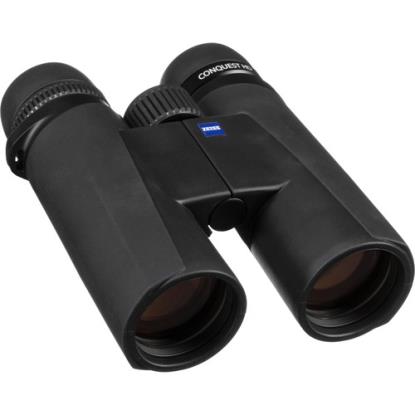
Zeiss Conquest 10x42 HD binocular
Zeiss Conquest 10×42 HD

A golden-mean objective that still gathers light at dawn and dusk. Waterproof to 13', nitrogen-filled and fog-proofed, with HD glass and up to 90% light transmission.
Approx. $999.99 USD
View product →
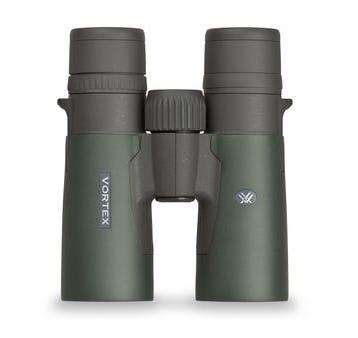
Vortex Razor HD 10x42 binocular
Vortex Razor HD 10×42

A step up, with a best-in-class HD optical system for the sharpest images in its class, covered by Vortex's lifetime warranty.
Approx. $1,299.99 USD
View product →
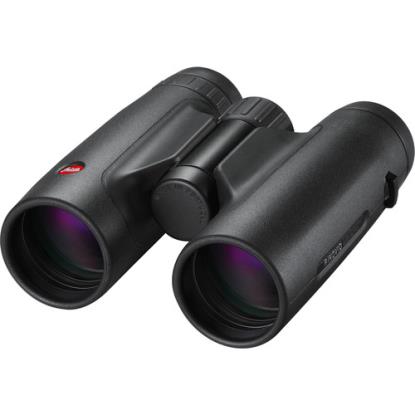
Leica Trinovid 10x42 HD binocular
Leica Trinovid 10×42 HD

Phase-corrected, multi-coated prisms for high-contrast, true-colour images. A light magnesium chassis with rubber armour, waterproof and fog-proof, plus Leica's Adventure Strap system.
Approx. $999.00 USD
View product →
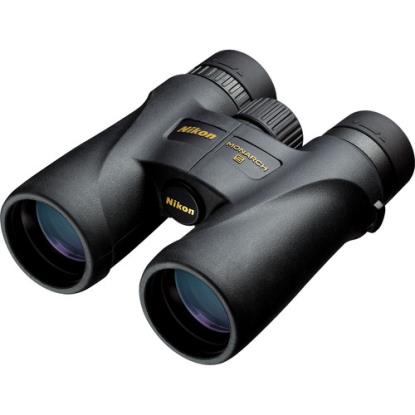
Nikon Monarch 5 10x42 binocular
Nikon Monarch 5 10×42

Fully multicoated ED-glass optics and phase-corrected roof prisms in a rubber-armoured, fog-proof housing. A 5.5° field of view that focuses to within nine feet.
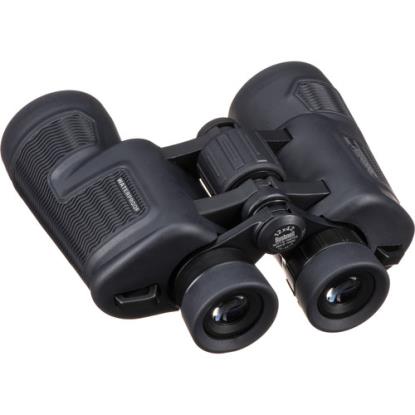
Approx. $296.95 USD
View product →
Bushnell 12x42 H2O Porro binocular
Bushnell 12×42 H2O Porro

A compact, weather-sealed, fog-proof body with multicoated BAK4 prism glass for clear, bright, detailed images.

Approx. $99.99 USD
View product →

Image-stabilised binoculars are available but tend to be expensive and heavy, so they are not included here.

Spotting Scopes

Weigh portability against light-gathering: smaller 60–66 mm bodies travel easily, while larger objectives are brighter at distance and in low light. Angled eyepieces suit comfort, straight bodies are easier for beginners to aim. Eyepieces are sold separately on the Kowa models.
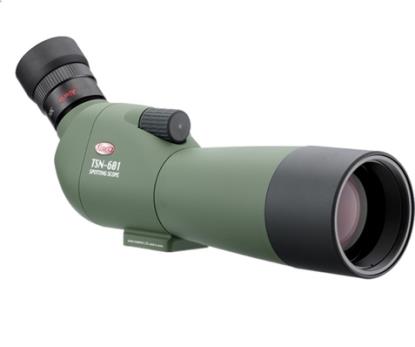
Kowa TSN-601 / 602 60mm spotting scope
Kowa TSN-601 / 602 · 60 mm

A mid-sized 60 mm objective with good light-gathering in a compact, waterproof, fog-proof body. The 601 is angled, the 602 straight; eyepiece purchased separately.
Approx. $500 USD
View product →
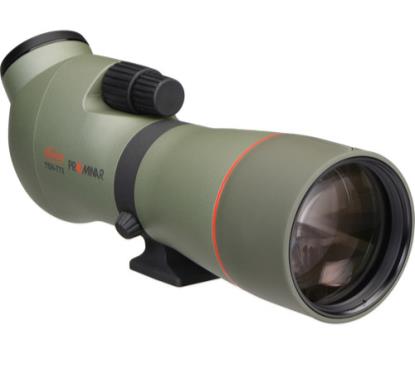
Kowa TSN-773 / 774 Prominar XD 77mm spotting scope
Kowa TSN-773 / 774 Prominar XD · 77 mm

XD (extra-low dispersion) glass and Kowa's C3 multi-coatings minimise chromatic aberration for crystal-clear, high-contrast images, in a magnesium-alloy body. The 773 is angled, the 774 straight; eyepiece required.
Approx. $1,549 / $1,600 USD
View product →
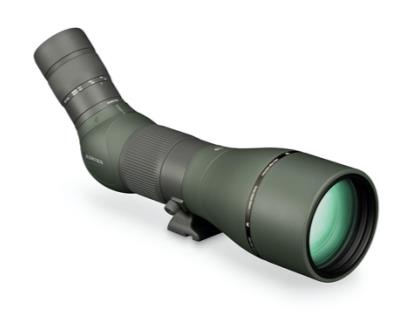
Vortex Razor HD 27-6085 spotting scope
Vortex Razor HD 27-6085

A high-end scope: advanced optics deliver distortion-free, flat-field images with edge-to-edge sharpness, strong resolution and colour accuracy.

Approx. $1,999.99 USD
View product →

Tripods

A good tripod that can carry a heavy scope is essential, since scopes are used mostly aboard. Heads are sold separately: look for a ball or video head that pans and tilts rather than a fixed camera head.
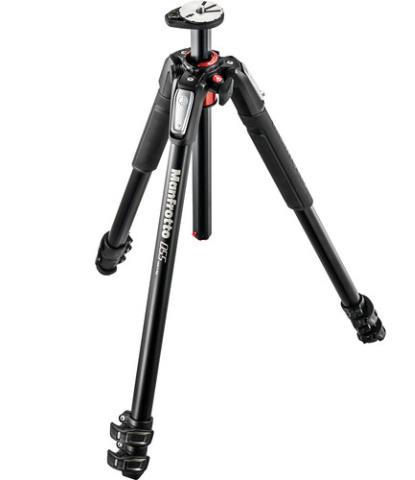

Manfrotto MT055XPRO3 aluminium tripod
Manfrotto MT055XPRO3 Aluminium

A three-section support with a 19.8 lb load capacity that extends from 3.5" to 66.9". Quick Power Locks add rigidity, a centre column swings horizontal for low-angle work, and a 360° bubble level sits on the head mount.

Approx. $208.87 USD
View product →
Capturing the Trip

Photography

The light, the wildlife and the landscapes make Iceland one of the most rewarding places to photograph. A few things worth knowing before you sail.

In the Field

For the camera and lenses you bring on deck and ashore.

  • A super-wide lens is ideal for the vast landscapes.
  • For distant wildlife such as whales and seabirds, a fast, long lens or high zoom helps; image-stabilised lenses are recommended.
  • Cold saps battery power: carry spares, and keep batteries close to your body to stay warm.
  • Rain and sea spray are constant, so keep your gear in waterproof bags.
  • Keep your camera on a strap on deck to avoid dropping it.
  • Mind the weight of the gear you carry ashore.
  • A tripod helps ashore but not on a moving vessel; a monopod or beanbag steadies shots aboard.
  • Onboard internet is limited, so plan to keep photos on your phone or laptop. Drone use is restricted in Iceland's national parks and reserves, so check the current rules before you fly.

On Your Phone

Tips for shooting on a phone.

  • Tap to set focus, then nudge exposure down a touch: bright snow and ice fool auto-exposure and leave shots grey and flat.
  • Turn on the grid and keep the horizon level; on open water a tilted horizon is the giveaway of a rushed shot.
  • Use burst mode for wildlife and breaching whales: hold the shutter, pick the best frame later.
  • Carry a microfibre cloth; sea spray on the lens is the most common reason a phone shot comes out soft.
  • Cold drains phone batteries fast, so keep your phone in an inside pocket and bring a power bank ashore.
  • In the long Icelandic summer light, shoot toward the low sun and lock exposure on the brightest part of the sky for richer colour.
For Further Information

See You
in Reykjavík

Reykjavík to Akureyri aboard M/Y Ocean's Seven, 18 – 25 July 2026. Your EYOS expedition team will be in touch before departure. Any questions in the meantime, we are glad to help.

EYOS Expeditions
info@eyos.com · www.eyos.com